Liquid Wisdom: The White Elephant in the Courtroom – Ghana’s Justice System & the Call for Common-Sense Reform
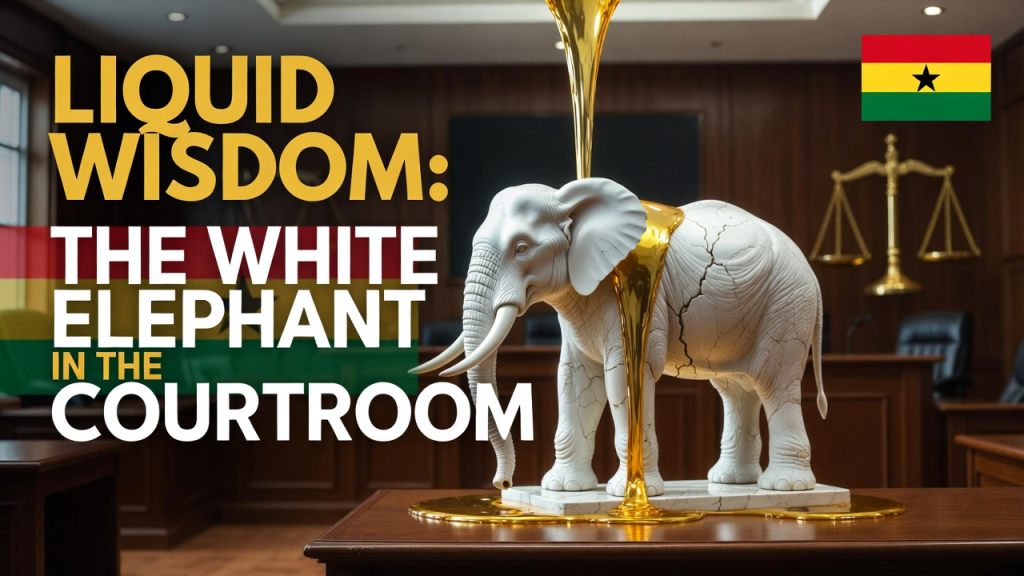
Liquid wisdom flows today into one of the most sensitive yet most critical spaces in our nation: the courtroom. Sixty-nine years after independence, we still carry a legal system that often feels more like a colonial taskmaster than a Ghanaian instrument of justice. This is not an attack on the judiciary. It is a sober, common-sense patriotic look at how punishment is weighed, how power is protected, and how ordinary Ghanaians bear the heaviest load. Let us examine the cracks honestly — and ask what true justice for Ghana and her people should look like.
The Colonial Inheritance: Maximum Punishment for the Slightest Offence
The roots run deep. The legal framework we inherited was never designed for free African people. It was fashioned under colonial rule to control, punish, and extract. In the slave era and colonial period, the slightest offence by a slave or “native” attracted maximum punishment — not to correct, but to deter and dominate. That spirit still lingers in many of our proceedings and outcomes. Today, the same legal system moves with remarkable speed and severity when dealing with ordinary citizens. Petty theft, traffic offences, minor disorder, buying stolen goods, or even hunting in a protected forest can result in years behind bars. A Ghanaian recently received five years for buying stolen goods. Another got three years for “poaching” — a term itself imported from European game laws that reserved hunting for elites and criminalised local communities who had lived off the land for centuries. The word “poacher” arrived with colonial administrations, not with the slave trade. It was part of imposing European ownership rules on African forests and wildlife. Compare this to the West. In many European countries and parts of the US, the same minor offences often attract a ticket, a warning, community service, or a fine. The goal is correction and restitution, not long-term warehousing of citizens. In Ghana, the default for many small offences is imprisonment — even when the harm is minimal and the offender could be put to productive use. Liquid wisdom asks: Did we, as an independent nation, ever sit down and consciously fashion a justice system that fits Ghanaian realities, values, and development needs? Or did we simply inherit and continue the slave-master punishment mode with a new flag on the courthouse?
The Double Standard: Swift on the Weak, Slow on the Powerful
The imbalance becomes glaring when we look at who the system moves against and who it seems to sleep on.When ordinary citizens are involved — a pastor gathering members during the questionable COVID-19 lockdown, a young man buying second-hand goods that turned out to be stolen, a hunter in a forest reserve — the system runs full course to a swift and often harsh result: imprisonment. But when the accused are public officers, government officials, or high-profile figures alleged of malfeasance, negligence, or massive financial mismanagement — offences that cause far greater harm to the nation’s economy and development — the same system often moves at a glacial pace. Cases drag for years with no final destination. Some never reach conclusion. Proceedings stall. Evidence disappears. The public watches in frustration as the powerful seem shielded by delay, technicalities, or selective enforcement. A glaring modern example is illegal mining (galamsey). Small-scale miners, individual operators, and especially foreigners have devastated rivers, farmlands, forests, and water bodies for years — with video evidence, satellite images, destroyed cocoa farms, mercury poisoning in communities, and long-term ecological disaster readily available. The economic, health, wellbeing, and environmental impact is catastrophic — far greater than any petty theft or minor forest offence. Yet the legal system appears almost absent or non-functional in many cases. Arrests are rare, prosecutions are inconsistent, and convictions even rarer — especially for foreign operators or well-connected figures. Some cases do reach court, but momentum fades quickly. The same energy that swiftly sends an ordinary Ghanaian to prison for years over a minor offence seems mysteriously absent when the crime destroys entire ecosystems and livelihoods for generations.This is not perception alone. It is a pattern visible to every Ghanaian who follows the news. The system is extremely active when the offender is ordinary. It becomes almost non-functional or absent when the offender holds power, wears a suit, or has foreign backing. Common-sense patriotism cannot accept this as normal. Justice must be blind — not selectively blindfolded when power or foreign interests are involved.
The Chief Justice’s Remark – A Window into Motivation
When a magistrate sentences someone to three years for stealing a bunch of plantain, people in Accra might scoff. But do you know what a bunch of plantain means to a woman in rural areas? It’s like stealing a car in the city
“I gave him 70 years, and what I told myself was that if Ataa Ayi was given 30 years and he came back, my family would be the first he would attack. So by the time he comes back after 70 years, I’ll be dead and gone – Chief Justice Paul Baffoe‑Bonnie
During the vetting of the current Chief Justice, a striking comment was made. When asked about sentencing decision, he stated that he gave a 70-year sentence to an accused so that “by the time he comes out, I would be dead and gone.” He framed it around personal fear rather than public safety or the letter of the law. Liquid wisdom does not question the gravity of serious crimes. But it does question the motivation behind sentencing. When punishment begins to reflect the personal fears or feelings of the judge rather than the law, proportionality, and societal good, something fundamental has shifted. The Chief Justice’s plantain analogy and personal framing raised eyebrows across the country. It begged the question: How many other long sentences have been influenced by similar human considerations rather than strict legal principles? And what does this say about the ultimate goal of our justice system — retribution, deterrence, rehabilitation, or something else?
The Way Forward – A Justice System That Serves Ghana First
Common-sense patriotism does not call for softness on crime. It calls for wisdom, proportionality, and national interest.
- Minor offences should have graduated responses: tickets, warnings, community service (especially in a country with so much undone sanitation, environmental, and public works). Prisons should not be the default warehouse for every small infraction.
- High-profile corruption, malfeasance, and large-scale crimes like galamsey must face the same speed, seriousness, and finality as ordinary cases. Delay is not justice; it is denial of justice to the people.
- Sentencing must be guided by law, evidence, and public good — not personal fear or emotion.
- Ghana must consciously review and reform its inherited legal framework. We need a system fashioned for our realities — one that punishes appropriately, rehabilitates where possible, and serves development rather than colonial hangover.
We are a nation of strong, intelligent, able people. Our legal system should reflect that strength — not continue patterns designed to control and punish the weak. Liquid wisdom flows into the cracks of our justice system today not to destroy, but to mend. The goal is not vengeance. The goal is a Ghana where every citizen — rich or poor, powerful or ordinary — believes justice is fair, swift when needed, and ultimately serves the progress of our beloved motherland.
For Nkrumah’s vision, for the ordinary Ghanaian behind bars for minor offences, for every victim of high-level impunity and galamsey devastation: Awake, Black Star. Let us build a justice system worthy of a free and sovereign people.
Forward ever, backward never.
Ghana first — in the courtroom and in the nation. NSG News | Ghana – Ghana first, always.
Share your awakening. Let the liquid wisdom flow.
Ghana Must Work, Ghana Can Work, Let’s Make Ghana Work – Eamn Liquid
Liquid Wisdom in a common-sense patriotism cutting through the noise, the theatrics, the twist and spins, politicking, partisanship and tribalism for Ghana – Eamn Liquid
By Eamn Liquid for NSG News | Ghana – 9th March 2026.