
Benin Launches Manhunt After Foiled Coup Led by Presidential Guard Officer
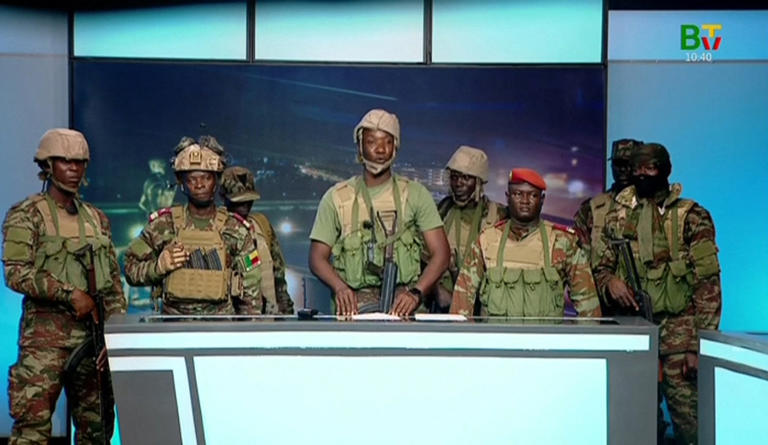
Benin’s security forces are conducting a large-scale manhunt for the leader behind Sunday’s attempted coup, a short but violent mutiny that left casualties on both the loyalist and rebel sides, authorities confirmed on Monday.
The coup attempt, which unfolded in the early hours of the morning, was aimed at toppling President Patrice Talon but collapsed within hours after swift military intervention supported by neighbouring countries.
In an official statement, Government Secretary Edouard Ouin-Ouro said the rebellion began around 5 a.m., when mutinous soldiers launched a surprise assault on the president’s location. Loyal troops “overwhelmed” the attackers after a fierce exchange, he added.
Regional Forces Step In
Benin’s government confirmed that Nigerian and Ivorian forces played key roles in suppressing the attempted takeover. Nigerian military aircraft were deployed to disable armoured vehicles used by the rebels, while ground forces helped secure critical sites.
Authorities announced several arrests but revealed that the alleged mastermind of the coup remained at large. Two senior military officers taken hostage during the mutiny were safely rescued, though officials did not disclose casualty figures.
A national investigation is underway to identify all perpetrators and possible sponsors. The cabinet convened an emergency meeting chaired by President Talon to assess the situation and stabilise national institutions.
Rebel Soldiers Broadcast Coup on National TV
Earlier on Sunday, a group of soldiers identifying themselves as the Committee for Refoundation seized the state television station and declared the removal of President Talon. Eight uniformed officers appeared on air, led by Lieutenant Colonel Pascal Tigri.
Tigri, previously a member of the president’s protection team and a former National Guard battalion commander, announced the dissolution of government structures and the suspension of state institutions.
By midday, Benin’s military backed by Nigerian air and ground operations neutralised the coup and pursued fleeing rebels.
Calm Returns, but Questions Remain
By Monday, relative calm had returned to the administrative capital, Cotonou, with soldiers maintaining a visible presence on major streets.
President Talon condemned the coup attempt as a “senseless adventure,” vowing that all mutineers would face justice.
ECOWAS announced the deployment of a standby regional force to support Benin’s democratic order. Troops from Nigeria, Ghana, Ivory Coast and Sierra Leone formed part of the contingent, though the size of the deployment remains undisclosed. Nigeria confirmed that Benin had formally requested assistance.
A Rare Shock in a Historically Stable Democracy
Benin, once vulnerable to coups after independence from France, has enjoyed nearly two decades of stability. Talon is expected to leave office after completing 10 years in power, with presidential elections scheduled for April.
The failed coup comes at a time when West Africa is grappling with a resurgence of military takeovers. Analysts say Nigeria’s quick intervention reflects its strategic interest in avoiding further instability along its borders and deterring the spread of military rule.
Security researcher Oluwole Ojewale noted that Nigeria “cannot afford to be encircled by hostile governments,” especially amid its own domestic security challenges.
However, geopolitical analysts also pointed out inconsistencies in ECOWAS’ approach to regional crises, arguing that the bloc’s reactions to coups in Gabon, Guinea-Bissau and other states have lacked uniformity.
As investigations continue, Benin faces a delicate period ahead of its upcoming elections, with authorities promising full accountability and a transparent probe into the mutiny.