Echoes of Betrayal: Ghana’s Enduring Struggle 60 Years After the Coup Against Osagyefo Dr. Kwame Nkrumah
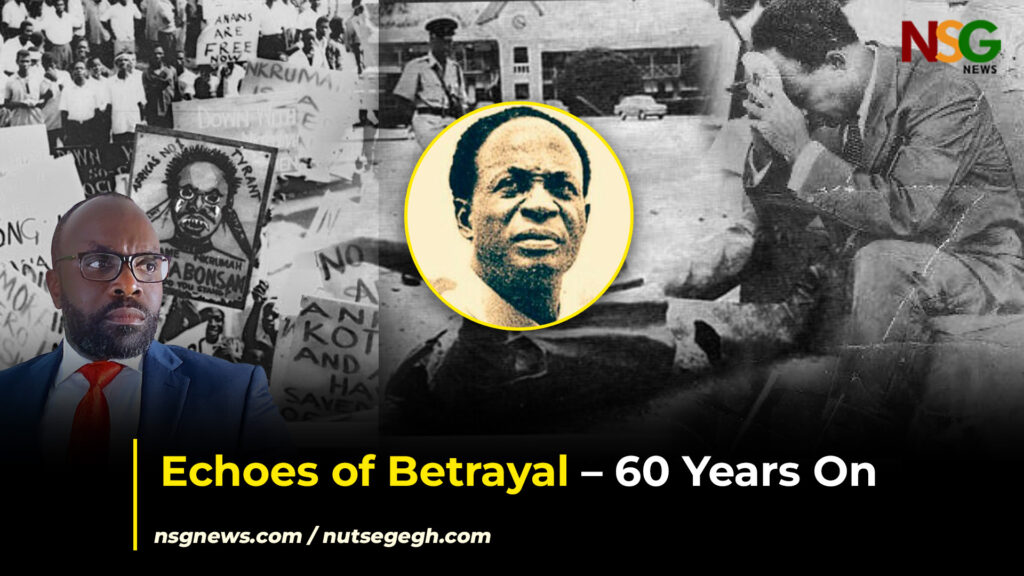
By Eamn Liquid – NSG News | Ghana
In honour of Osagyefo Dr. Kwame Nkrumah, the visionary architect of Ghana’s independence and Pan-African unity, as we approach the 60th anniversary of the tragic coup on February 24, 1966. This piece, infused with liquid wisdom and common-sense patriotism, reflects on how the derailment of Nkrumah’s path to true sovereignty continues to suffocate Ghana under Western economic chains.
Let us reclaim our narrative for self-sufficiency and African solidarity.
A Legacy Interrupted
Osagyefo Dr. Kwame Nkrumah, Ghana’s founding father and a beacon of Pan-Africanism, dreamed of a sovereign, self-sufficient nation leading the charge toward African unity. His strategic vision encompassed industrial growth, energy independence, and ideological resistance to neocolonialism.
Yet, on 24th February 1966, while abroad in China, a military coup infamously dubbed “Operation Cold Chop“, toppled his government. This was no mere internal uprising; it was a calculated sabotage orchestrated with foreign interference, setting Ghana on a path of dependency that persists today. As we mark the 60th anniversary in 2026, Ghana remains ensnared in a web of external loans from the IMF, World Bank, and other institutions, labouring under what economist Prof. Michael Hudson describes as Western economic servitude.
Nkrumah’s trajectory structural development for sovereignty, self-sufficiency, and unity has been circumvented, leaving projects like the Atomic Energy Commission at Haatso as little more than white elephants. Once envisioned as a cornerstone for energy sufficiency through atomic power, it symbolizes unfulfilled potential amid Ghana’s ongoing energy crises.
This article explores the coup’s roots, its enduring economic fallout, the skewed Western systems perpetuating Africa’s disadvantage, and the racial underpinnings that fuel this tragedy—all in a spirit of patriotic reflection to inspire renewal.
The CIA’s Shadow
Unmasking the Overthrow of Nkrumah Declassified U.S. documents and historical testimonies paint a damning picture of CIA involvement in Nkrumah’s downfall. Viewed through the Cold War lens, Nkrumah’s socialist policies, alliances with the Soviet Union and China, and push for African unity were deemed threats to Western interests. Key revelations include:
- In 1964, U.S. officials devised an “action program” to undermine Nkrumah, halting funding for critical projects like the Volta (Akosombo) Dam, launching psychological operations to erode public support, and forging alliances with anti-Nkrumah elements in the Ghanaian military.
- Former CIA officer John Stockwell, in his 1978 memoir In Search of Enemies, exposed how the CIA’s Accra station advised and supported coup leaders like Emmanuel Kwasi Kotoka and Akwasi Afrifa. This occurred with minimal oversight, highlighting rogue agency elements.
- A 1965 meeting between U.S. Ambassador William P. Mahoney and CIA Director John McCone discussed coup plots, with predictions of a military junta takeover. Post-coup CIA communications confirmed close ties with plotters.
- Historians like Martin Meredith and statements from Ghanaian President John Mahama in 2025 affirm CIA orchestration, noting how U.S. economic pressures worsened Ghana’s finances to ripen conditions for the overthrow.
While some U.S. officials downplayed direct execution, claiming advisory roles, the evidence points to financial, intelligence, and logistical support. This intervention mirrored broader U.S. strategies to counter “communist” influences in Africa. Recent discussions on X (formerly Twitter) by users like @farrah_man and @lordcudjoe reinforce this, debating Nkrumah’s legacy while confirming CIA backing.
The coup’s Ammediate Aftermath Reversed Nkrumah’s Gains
Industries were privatized, Pan-African initiatives stalled, and Ghana opened doors to Western exploitation. Today, this betrayal manifests in Ghana’s debt burden—over $50 billion in external loans by 2026—trapping the nation in cycles of austerity dictated by the IMF and World Bank.
Circumventing Nkrumah’s Vision
From Self-Sufficiency to Servitude Nkrumah’s ideology emphasized structural and strategic development for true sovereignty. He championed import substitution, heavy industrialization, and energy independence. The Atomic Energy project at Haatso, initiated in the 1960s, aimed to harness nuclear power for electricity and research, positioning Ghana as a technological leader in Africa. Yet post-coup neglect has rendered it underutilized – a “white elephant” amid blackouts and reliance on imported fuels.This derailment exemplifies broader circumvention:
- Economic Dependency: Ghana’s economy, once geared toward self-reliance, now suffocates under IMF/World Bank schemes. Prof. Hudson critiques these as tools of “economic servitude,” where loans fund extractive industries benefiting the West, while conditionalities enforce privatization and cuts to social services.
- Debt Traps: By 2026, Ghana’s debt-to-GDP ratio hovers at 80%, with repayments diverting funds from education, healthcare, and infrastructure. Nkrumah warned against such neocolonialism in Neo-Colonialism: The Last Stage of Imperialism, yet successive governments have deepened ties to these institutions.
- Lost Trajectory: Nkrumah’s push for African unity—through the Organization of African Unity (now African Union)—sought collective bargaining power. Instead, fragmented policies have left Ghana vulnerable, importing essentials it could produce domestically.
In Common-Sense Patriotism, we must ask:
Why borrow billions for basics when Nkrumah’s blueprint offered homegrown solutions? The coup not only ousted a leader but hijacked a nation’s destiny. How Western Economic Systems Skew Against Africa.
The coup against Nkrumah was symptomatic of systemic biases in Western economic structures, designed to perpetuate Africa’s subordination. Rooted in colonialism, these systems—via the IMF, World Bank, and global trade—favour the Global North.
| Aspect | Western Skew | Impact on Africa |
| Trade | Focus on raw exports; limited diversification | Economic vulnerability; lost opportunities in manufacturing/services |
| Debt/Finance | Higher costs due to biases; IMF dominance | Perpetual debt; austerity measures |
| Media/Perception | Negative stereotypes | Reduced FDI; higher borrowing rates |
| Institutions | Voting power favours Global North | Policies that reinforce inequality |
- Commodity Dependency: Africa’s exports (e.g., Ghana’s cocoa and gold) are raw, with intra-continental trade at just 18%. Western markets dictate prices, while neoliberal IMF policies flood markets with cheap imports, halting local growth.
- Financial Biases: African nations face inflated borrowing costs due to “risk perceptions.” Ghana’s President Nana Akufo-Addo has labeled this system “skewed against emerging economies,” with IMF voting rights dominated by the U.S. and Europe.
- Investment Barriers: Stereotypes of corruption and instability deter capital, costing billions. Yet, as investor Tony Elumelu notes, Africa’s ROI potential is unmatched if biases were dismantled.
Critics view this as neocolonialism, exacerbated by internal issues like governance flaws. For Ghana, it means endless loans for “development” that enrich foreign entities, echoing Nkrumah’s warnings.
Racial Underpinnings:
The Hidden Thread of Exploitation Racial dynamics are the unspoken foundation of these economic skews, evolving from colonialism and slavery into modern “racial capitalism.” Thinkers like Cedric Robinson argue capitalism thrives on racial hierarchies, positioning Africa for extraction.
- Historical Roots: The trans-Atlantic slave trade and colonialism racialized exploitation, justifying African subjugation for Western gain. This legacy endures in global disparities.
- Contemporary Forms: Structural racism limits access to resources for Africans and the diaspora. In Western economies, wealth gaps (e.g., Black families at 12% of white wealth) parallel Africa’s position. Media myths of inferiority sustain unequal trade.
- Pan-African Resistance: Leaders like Marcus Garvey and W.E.B. Du Bois called for solidarity. Today, demands for reparations and fair governance challenge these hierarchies.
The CIA’s role in Nkrumah’s ouster was part of a racialized strategy to control African resources, intertwining Cold War fears with imperial racism.
For Ghana, this means ongoing struggles against systems that undervalue Black sovereignty.
Reclaiming Nkrumah’s Liquid Wisdom for a Sovereign Future
As we near the 60th anniversary of the coup, Ghana’s suffering—debt suffocation, energy shortfalls, and lost unity—demands reflection and action. Osagyefo Dr. Kwame Nkrumah’s philosophy of self-sufficiency and African solidarity remains our guiding light.
In common-sense patriotism, let us reject Western servitude, revive projects like Haatso’s atomic energy, and forge intra-African alliances.
The tragedy of 1966 was not just a coup; it was a theft of destiny.
But liquid wisdom flows eternally — let it quench our thirst for true independence.
For Nkrumah, for Ghana, for Africa: Forward ever, backward never!
Eamn Liquid (Liquid Wisdom) – Cutting through the noise for Ghana and Africa!

1 thought on “Echoes of Betrayal: Ghana’s Enduring Struggle 60 Years After the Coup Against Osagyefo Dr. Kwame Nkrumah”