Ghana’s Chief Justice Torkornoo Sues State at ECOWAS Court, Seeks $10 Million for Rights Violations
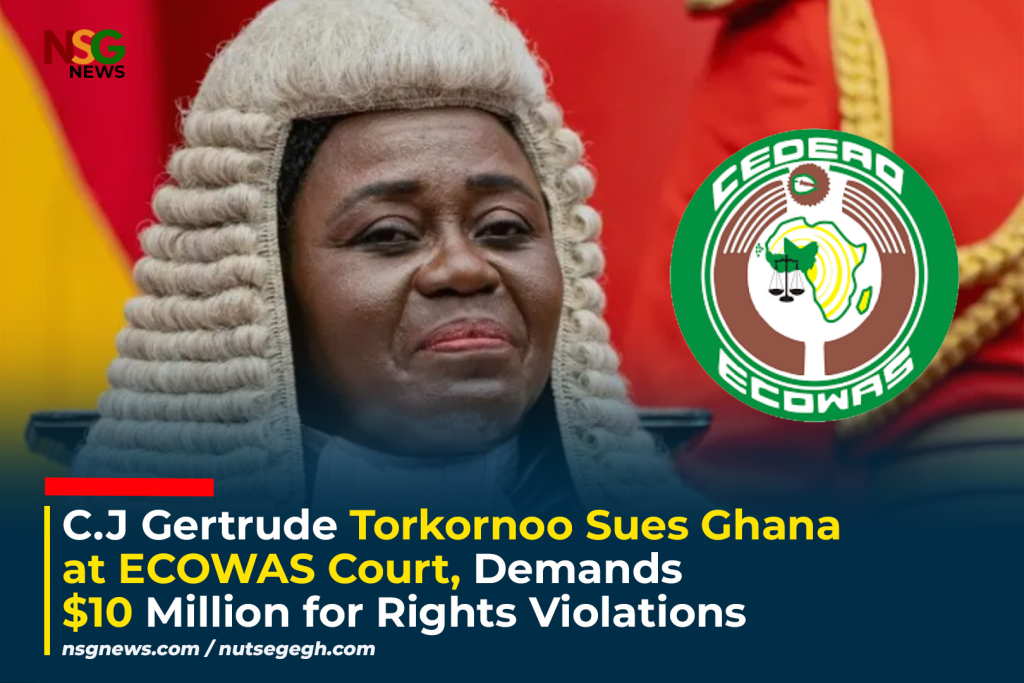
Chief Justice Gertrude Torkornoo has filed a lawsuit against the Government of Ghana at the ECOWAS Court, demanding $10 million in compensation for alleged violations of her fundamental rights and reputation.
The Chief Justice’s legal action challenges her recent suspension from office by President John Dramani Mahama and questions the constitutional process initiated for her possible removal. This is the first time in Ghana’s 68-year post-independence history that a sitting Chief Justice has been subjected to removal proceedings, placing the case under intense public and legal scrutiny.
According to filings confirmed by sources close to the judiciary, the Chief Justice argues that her suspension on April 22, 2025, constitutes a serious violation of her fundamental human rights as protected under the African Charter on Human and Peoples’ Rights.
What the Chief Justice Is Demanding
Among the declarations sought in her suit, Justice Torkornoo is asking the regional court to affirm that:
Her right to a fair hearing under Article 7 of the African Charter has been violated.
The panel established to investigate allegations of misconduct against her lacked independence and impartiality, further infringing her right to a fair trial.
Her right to fair, equitable, and satisfactory conditions of work under Article 15 has been breached.
Her suspension has subjected her to public ridicule and damage to her dignity, a violation of Article 5 of the Charter.
The ongoing process has caused lasting harm to her professional standing and exposed her family to “immeasurable public ridicule.”
The suit argues that these experiences amount to psychological and social harm, with real consequences for her legacy, her career, and her family.
Background: How We Got Here
The case stems from President Mahama’s decision to suspend Chief Justice Torkornoo under Article 146 of the 1992 Constitution, which outlines the procedure for removing Justices of the Superior Courts. That process involves the Council of State determining whether a prima facie case exists, followed by the establishment of a committee of inquiry.
Chief Justice Torkornoo had earlier sought legal redress through Ghana’s own courts. Her application to halt the proceedings at the Committee of Inquiry was dismissed by the Supreme Court in May 2025, which ruled against her on procedural grounds. However, the core constitutional questions about the legality of the process remain unresolved and are still being litigated domestically.
Faced with what she views as a denial of due process and continuous reputational harm, the Chief Justice has now turned to the ECOWAS Court. The regional human rights court based in Abuja, Nigeria, has jurisdiction over alleged violations of human rights committed by member states, including Ghana.
Why This Case Matters
Legal observers and constitutional experts in Ghana and across West Africa have taken a keen interest in the case. While some argue that international courts should only be approached after exhausting local remedies, others point out that ECOWAS Court precedent allows simultaneous or parallel proceedings as long as the matter is not before another international tribunal.
Justice Torkornoo’s case raises major questions about judicial independence, constitutional interpretation, and political accountability. As the head of Ghana’s judiciary, her decision to seek redress beyond the country’s borders may set a precedent for other high-ranking officials who feel targeted or unfairly treated by constitutional processes.
The case also highlights broader debates about the separation of powers in Ghana, particularly the delicate balance between the executive and judiciary. Public trust in democratic institutions is at stake, and the ECOWAS Court’s eventual ruling could reshape expectations for how senior judicial figures are treated under the law.
Looking Ahead
The ECOWAS Court of Justice will be watched closely as it proceeds with this high-profile and sensitive matter. Its judgment may not only affect the career of Chief Justice Torkornoo but could also influence how constitutional justice is pursued in Ghana and across the West African region.
Whether the court grants the 10 million dollar compensation or not, the case has already triggered important national conversations. At the heart of it lies a critical question: How should Ghana protect the rights of its highest judicial officers while preserving the integrity of its constitutional checks and balances?
Kofi Asante, NSG News